Together, we can strengthen stroke systems of care so that patients nationwide have access to neuroendovascular stroke surgery and the best possible chance for recovery. In this booklet, learn how you can help the Get Ahead of Stroke® campaign educate and persuade state leaders nationwide that appropriate triage and transport of stroke patients is not only a good idea but a model that already works for other conditions, such as heart attack and trauma.

Read the brochure online!

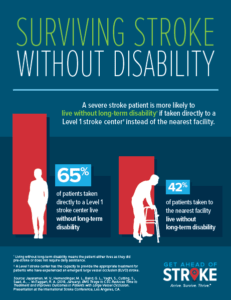
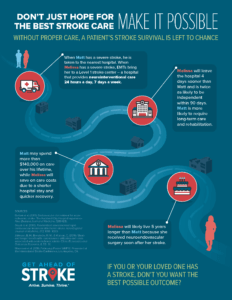
This infographic shows that severe stroke patients taken directly to a Level 1 stroke center are less likely to live with disability than patients taken to the nearest facility. This visualization will help viewers understand the importance of receiving the appropriate care in a timely manner.

The Get Ahead of Stroke® campaign has relaunched the Stroke Scales for EMS mobile app. This tool helps first responders and EMS personnel assess a patient’s stroke severity.

By measuring, for example, the patient’s ability to squeeze and release a hand or make facial expressions—physical indicators of an emergent large vessel occlusion—the scales help first responders determine the best course of action for the patient. With this information, the app then recommends the type of facility where the patient can receive appropriate care. Results can then be sent via SMS or email.

You’ll notice a sleeker look, easy-to-navigate format, and robust FAQ section for EMS personnel to learn more about stroke. Downloaded by more than 50,000+ EMS since its relaunch, we hope that this application will make it easier for more patients to survive and thrive after stroke.

It is available for download in the iTunes App Store and on Google Play.

Learn more about the app and help spread the word with these useful resources.

  • Mobile app postcard: This postcard provides an easy way to download the Stroke Scales for EMS app via the QR code and remind the user that the app can be downloaded in the iTunes App Store or on Google Play.
  • Social media graphics: The graphics promote the app and remind the user that the app can be downloaded in the iTunes App Store or on Google Play.
Meet Gisele Barreto Fetterman. Her husband, U.S. Senator John Fetterman, experienced a stroke in early 2022. He benefited from a lifesaving surgery called thrombectomy, a minimally invasive procedure that restores blood flow to the brain. Together, we can help more patients get appropriate care. #SurviveStroke

Scott survived stroke; he received a lifesaving thrombectomy. As a former paramedic, he knows how important it is to recognize the signs of severe stroke.

This postcard can be used as promotion for the Stoke Scales for EMS mobile app. It provides an easy way to download the Stroke Scales for EMS app via the QR code and reminds the user that the app can be downloaded in the iTunes App Store or Google Play.

Getting appropriate care in time can be the difference between life, death, and disability. Four patients describe their experiences with thrombectomy.

Meet Kasondra. After neuroendovascular surgery, she’s regained movement and is on her way to recovery.

Help Make the Best Care Possible

This infographic shows the two paths to care that patients might take after a stroke, as well as the potential outcomes of each. This visualization will help viewers understand the importance of receiving the appropriate care in a timely manner.